
A few days ago, La Vanguardia published an article about MaserGrup’s new investment plan, written by journalist Luis Federico Florio, highlighting the group’s commitment to growth, innovation and international expansion.
Under the headline “MaserGrup to invest €100 million in factories and acquisitions”, the article focuses on the momentum of the group’s food division, led by Fruselva, as well as its ambition to continue gaining scale through new plants, strategic acquisitions and projects with a global vision.
At MaserGrup, we would like to share this publication, which reflects the group’s current growth phase and the commitment of our companies to innovation, industry, the region and the creation of new opportunities for the future.
The food division Fruselva drives the growth of the Catalan group based in Reus
MaserGrup, an industrial group based in Reus, is launching a €100 million investment plan to grow in scale through new plants and the acquisition of companies. Owner of food and beverage companies —Fruselva, Vermuts Miró—, construction materials firm TQ Tecnol and real estate company Setier, the group aims to double its size, growing from its current €224 million in revenue to between €400 and €500 million in three or four years. “We will have to take risks and innovate. The vision must be global. We are looking to grow with factories and companies that bring synergies, range, volume and innovation,” explains Xavier Martínez, founder and president of the group.
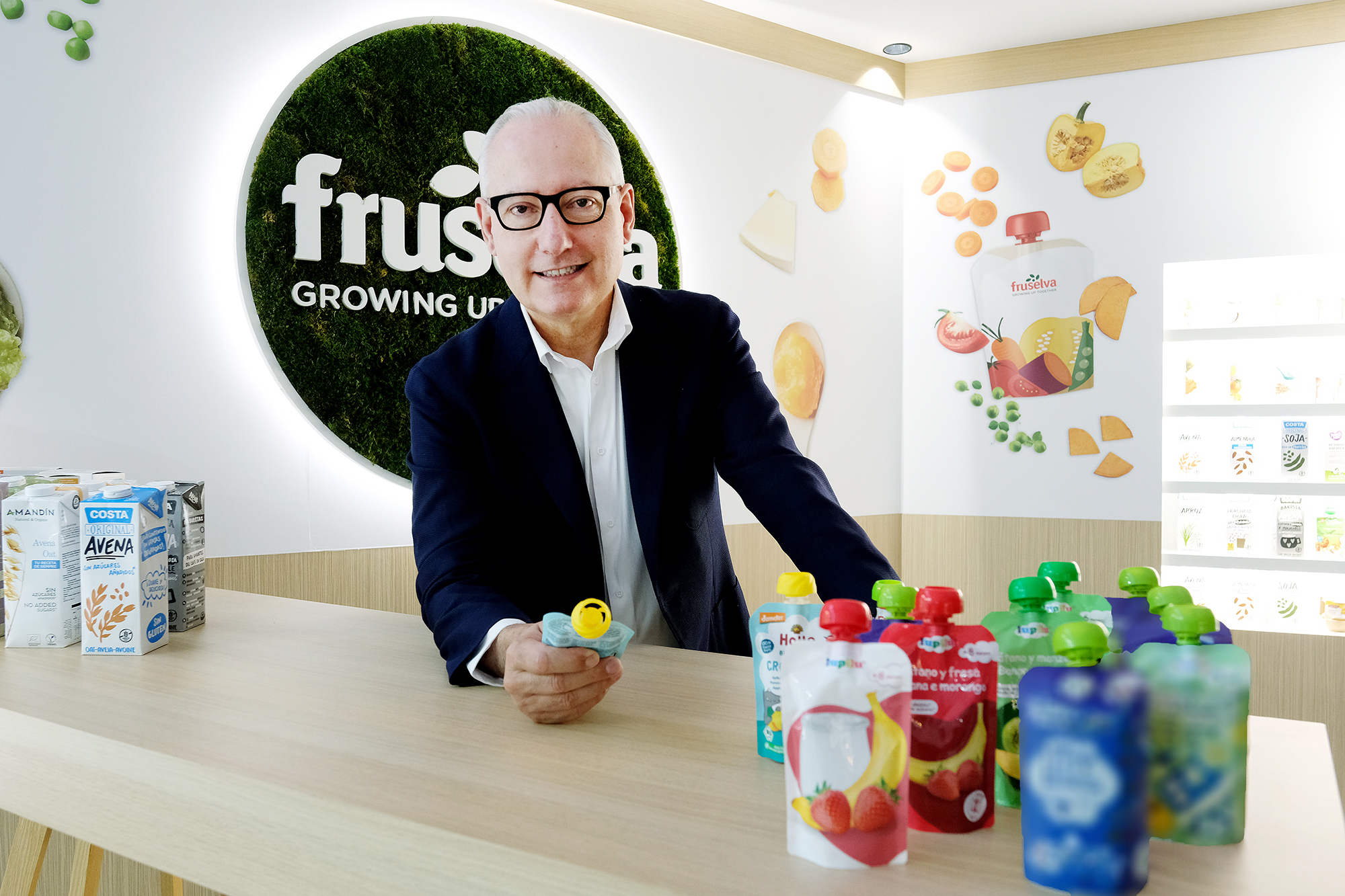
The jewel in the crown is Fruselva, focused on food, where it stands out in baby food jars, plant-based drinks and powdered milk —formula—, which it manufactures under its own brands or for third parties, such as supermarkets. The American giant Walmart and Germany’s Aldi and Lidl stand out among its clients. This division generates €190 million in revenue and reaches fifty countries. It specialises in pouches —flexible packaging that contains the food—, with a strong presence in the US —despite tariffs—, Canada and Latin America. Europe accounts for half of the business, and the Americas for the other half. “It is an increasingly important sector, where higher quality is needed, both in sweet and savoury products. We try to be very innovative,” he highlights. It is the area where he sees the greatest growth potential within the group’s portfolio. MaserGrup incorporated it in 2007 after buying a juice factory in Catalonia from the Austrian group Pago, which it immediately renamed Fruselva. Today, it has factories in Riudoms, Chile and Colombia, as well as its own land where it grows crops.
With the investment plan, the aim is to go from three to six factories. The focus is on the US, India and northeastern Europe. “We want to move from exporting to having a local presence,” he explains. These will also be the markets where the group explores acquisitions, with an eye on companies that do not have a clear succession plan, need resources or lack a global vision. “We have to be capable of reaching more countries,” he argues. Last year, the group already acquired Swiss baby food company Holle Baby Food and Vermuts Perucchi 1876.
The group was founded in 1997 with TQ Tecnol, a company specialising in technical materials for construction. After incorporating businesses through a previous investment plan of another €100 million in recent years, in 2025 the group posted total revenue of €224 million and profits of €9.5 million, a figure it expects to at least double by the end of the rollout of the new plan. Along the way, it estimates sales of €260 million this year. Its workforce, currently standing at 1,100 people, would grow by 50% once the investment cycle is completed.
In total, the group has five factories: Fruselva’s three plants and those of Vermuts Miró and TQ Tecnol. The forecast is to have ten by the time the investment plan is completed. Regarding the financing of this growth, the €100 million invested will be split equally between own resources and bank financing, Martínez details. The capital is fully controlled by the entrepreneur: he states that, if necessary for growth, alliances will be formed and the capital could be opened up, but on the condition that majorities are not lost “in the joint venture or on the board”.
Luis Federico Florio